



ARTICLES
Bain-Marie And Salad Bar

Presentation, Hygiene, And Cold-Hot Chain Management In Modern Gastronomy
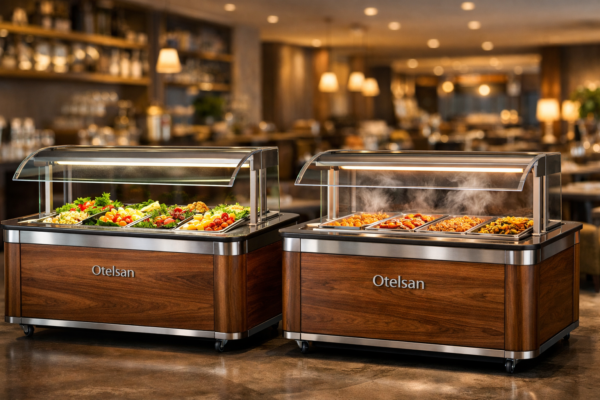
The professional food and beverage sector (Horeca) is a dynamic ecosystem where culinary taste alone is not sufficient; rather, operational speed, presentation aesthetics, food safety, and sustainable cost management must be seamlessly blended. Today, hotels, luxury restaurants, catering companies, and corporate dining halls aim to offer their guests a holistic dining experience rather than just a simple meal. The most critical and operationally sensitive point of this experience is formed by the open-buffet and self-service lines. The heart of open-buffet organizations and mass catering presentations is governed by two fundamental technologies that ensure foods are displayed under ideal service conditions: the Salad Bar and the Bain-Marie.
With its years of engineering experience and innovative design vision in industrial kitchen technologies, Otelsan redefines these two vital elements of the food service chain. In this article, we will deeply analyze the importance of preserving the cold and hot food chain in the modern culinary world, the technical parameters of Salad Bar and Bain-Marie technologies, their contributions to food safety (HACCP) standards, their integration with corporate architecture, and the professional kitchen solutions offered through Otelsan’s flagship models, including the 160 BN, 140 MS, 140 BN, and 130 MS.
SECTION 1: SUSTAINABILITY OF THE COLD AND HOT CHAIN IN INDUSTRIAL KITCHENS
In the gastronomy sector, preparing or cooking a dish with the right ingredients according to its recipe is only the first side of the coin. The other, and perhaps the most high-risk side, is how these prepared foods are preserved biologically, texturally, and flavor-wise until the exact moment of consumption. At this juncture, “Critical Control Points” come into play, dictating the operational success or failure of industrial kitchens.
The Importance of the Cold Chain and Bacterial Risk Management
Salads, cold appetizers, mezes, olive oil dishes, seafood starters, and sauces are, by their very nature, the food groups most susceptible to microbial proliferation. Salads containing poultry, dairy products, or mayonnaise-based dressings can breed toxic levels of bacteria within hours when left at room temperature—specifically within the dangerous temperature zone between 5°C and 65°C.
Cold chain management mandates that the core temperature of food must be continuously maintained at 4°C or below. Salad Bar units are not merely display furniture; they act as a biological shield preventing foods from entering this hazardous temperature danger zone. Inadequate cooling causes food to wilt, discolor, become watery, and, most critically, leads to foodborne illnesses, which can irreversibly damage an establishment’s corporate reputation.
The Hot Chain: Preserving Flavor Profiles and Preventing Dehydration
In the hot service chain, the situation demands an equally precise level of sensitivity. It is a legal and hygienic obligation to maintain cooked foods, soups, sauced main courses, and side dishes at a minimum temperature of 65°C throughout the service duration. However, merely keeping the food hot is not enough; the true success lies in keeping the food hot while preserving its intrinsic quality.
Foods exposed to direct heat or dry hot air experience rapid evaporation of their moisture, causing sauces to thicken excessively, protein structures to harden, and the bottom layers to burn and dry out. This situation leads to significant food waste (shrinkage) and drastically lowers the quality of the meal presented to the guest. Bain-marie technology utilizes the latent heat of evaporating water to warm foods indirectly, enveloping them in a gentle, humid heat. Consequently, the flavor profile, moisture balance, sauce consistency, and visual appeal of the dishes remain as fresh as the minute they were cooked during hours-long services.
SECTION 2: MODERN SALAD BAR TECHNOLOGIES AND TECHNICAL ANALYSIS
A professional salad bar unit must deliver an absolute feeling of freshness to the guest on the frontline, while simultaneously managing a complex thermodynamic cooling process in the background. The Salad Bar technologies developed by Otelsan represent the highest level of engineering solutions to achieve this delicate equilibrium.
Compressor Power and Refrigerant Cycle
The heart of a refrigerated salad bar is the commercial compressor housed within its body. In order for large-volume wells and the gastronorm pans placed inside them to remain constantly cold, the compressor power must be perfectly optimized to the volume of the basin. The 1/2 Hp high-performance commercial compressors utilized in the Otelsan 140 MS and 130 MS models deliver a cooling stability that stands far above standard industrial benchmarks.
The R-134a refrigerant gas utilized in the system is renowned for its eco-friendly thermodynamic properties. This gas does not deplete the ozone layer and features a high heat transfer coefficient, allowing the compressor to consume less electrical energy while achieving superior cooling yields. Especially in Mediterranean climate hotels where ambient temperatures run high, or near hot kitchen lines that generate heavy steam, this robust 1/2 Hp compressor architecture prevents the system from locking up or suffering performance degradation.
Forced-Air (Fan-Assisted) Cooling vs. Static Cooling
The greatest problem frequently encountered in traditional cooling units is that the bottom of the basin freezes while the top layer of the gastronorm pans approaches room temperature. In this method, called static cooling, because there is no active air circulation, the dense cold air settles entirely at the base of the well.
Otelsan utilizes advanced Forced-Air Cooling (Fan-Assisted) technology in its professional models. In this system, the cold air generated by the evaporator is continuously circulated within the well and around the gastronorm pans via industrial-grade fans. Thanks to this homogeneous air currents, not only the bottom of the pans but also their vertical side walls and the topmost layer of the food are cooled equally. Fan-assisted cooling eliminates temperature fluctuations, preventing the cellular breakdown of raw food structures; this keeps greens crisp, vegetables vibrant, and cold sauces at their correct viscosity.
Cost-Benefit Analysis of Polyurethane Insulation
Preventing the escape of cooling performance to the outside environment is just as critical as generating the cold air itself. The high-density polyurethane insulation applied by Otelsan to all cold structural surfaces transforms the unit’s chassis into a thermal wall. Injected in liquid form to create a microporous barrier upon solidifying, this polyurethane blocks external ambient heat from penetrating the internal basin while simultaneously preventing the internal cold air from escaping through the body.
The advantages this premium insulation provides to an establishment can be summarized under three primary headings:
- Energy Savings: Once the compressor reaches the temperature designated by the digital thermostat, the polyurethane insulation preserves that internal climate for a prolonged duration. The motor does not cycle on and off constantly, lowering electrical consumption to a minimum.
- Extended Motor Lifespan: Reducing the active duty cycle hours of the compressor minimizes mechanical wear and tear, ensuring long years of maintenance-free operation.
- Prevention of Condensation (Sweating): Poorly insulated units develop sweating and moisture droplets on their exterior wooden surfaces, which can degrade the woodwork over time and compromise floor hygiene. Polyurethane insulation cuts the temperature differential between the inner well and outer chassis, eliminating condensation entirely.
SECTION 3: THERMAL STABILITY AND HEATING SYSTEMS IN BAIN-MARIE TECHNOLOGY
In hot service lines, the factor that directly influences food quality is the power of the heating source and the manner in which this thermal energy is transferred to the food. Bain-marie units, unlike dry-heating alternatives, support food quality through the gentle power of water.
Wet-System (Bain-Marie) Operating Principle and Resistance Technology
Bain-marie literally translates to a water bath. The system operates on the principle of heating a specific volume of water placed inside a stainless steel well via electrical resistance heating elements positioned underneath or at the base of the basin. As the water temperature rises, the ascending hot steam strikes the bottom and side walls of the gastronorm pans placed above, transferring heat evenly to the food.
The industrial electrical heating systems used in Otelsan Bain-Marie units consist of specially coated resistances with high corrosion resistance. These elements ensure that the water reaches optimal serving temperatures rapidly. The indirect heat transfer provided by water allows thermal energy to penetrate the food mass homogeneously. For example, a thick cream soup or a starchy puree would scorch at the bottom within seconds if heated directly; however, inside an Otelsan Bain-Marie well, it can be maintained for hours without stirring, preserving its original consistency perfectly.
Chemical and Physical Durability of the Stainless Steel Basin
Bain-marie wells are in continuous contact with high-temperature water, water vapor, and acidic or salty food remnants that may spill from the pans. For ordinary metals, this environment represents an accelerated process of rusting, pitting, and perforation.
Otelsan utilizes high-alloy, food-grade stainless steel interior wells across all its bain-marie and salad bar models. This chemical steel composition demonstrates superior resistance to chloride ions, salty vapors, and aggressive commercial cleaning agents. Its ultra-smooth surface finish minimizes limescale accumulation and prevents the formation of microbially hazardous biofilms.
SECTION 4: ERGONOMICS, OPERATIONAL FUNCTIONALITY, AND STRUCTURAL DETAILS
The success of industrial kitchen equipment is measured not just by engineering data, but by the operational ergonomics it offers to the staff working on the floor and the guests receiving service. The Otelsan design team integrates high-level ergonomics into every structural detail of the units.
Integrated Liquid Drain Valve System and Hygiene Standards
Evacuating the residual hot water from a bain-marie well after service, or draining the condensation water and cleaning liquids from a salad bar well, is a severe operational burden. Attempting to empty the water from the basin manually using buckets or scoops leads to labor inefficiency and presents significant occupational safety hazards, such as severe burns and slipping risks.
The high-sealing integrated liquid drain valves engineered at the absolute base of Otelsan wells transform this process into a fully mechanical and safe operation. At the conclusion of service, the valve is opened to drain the liquid directly into a floor grate or drainage channel. The slight inclination of the basin floor toward the drain valve ensures that no dirty residual water stalls inside, reducing sanitation processes down to mere seconds.
Dual-Sided Foldable Service Trays and Space Optimization
Space management is a critical factor in open-buffet and self-service layouts. During peak hours, guests require stable surfaces to slide their plates, place trays, or arrange condiment bowls and serving utensils.
The mechanically foldable service trays flanking both long sides of models such as the Otelsan 140 MS, 140 BN, and 130 MS offer a smart solution to this structural need. Equipped with heavy-duty stainless steel support mechanisms, these decks are lifted and locked into place during service hours, transforming into an expansive slide stand. The width dimensions of the units are meticulously optimized for both extended and folded states:
- 140 MS and 140 BN Models: The width, which is a compact 73 cm when the trays are folded, expands to 114 cm when the decks are extended, providing a maximum service pathway.
- 130 MS Model: The chassis width of 70 cm when folded converts into an optimized 105 cm service area when extended.
- 160 BN Model: The narrow 62 cm base width expands to 110 cm of operational area when the trays are extended.
Following the conclusion of service, or during the transportation of the units back to the kitchen, these shelves fold downwards effortlessly, narrowing the overall footprint of the machine. This allows the units to navigate through narrow corridors, standard doorways, and service elevators seamlessly, occupying minimal floor space in storage rooms.
Concealed and Braked Heavy-Duty Swivel Wheels
Fixed service counters condemn an establishment to a single, unalterable dining room layout. Yet, flexibility is paramount in modern hospitality and catering operations. A buffet setup utilized for an indoor evening banquet today might need to be repositioned poolside or in an open-air garden tomorrow.
The 4 heavy-duty mechanical swivel wheels aesthetically integrated into the bottom skirt of Otelsan units grant them superior mobility. Equipped with heavy-duty bearings, these wheels allow the unit to be rolled quietly, smoothly, and without leaving marks on luxury flooring (thanks to their non-marking rubberized composition)—even when the unit is filled to capacity with water and heavy gastronorm pans. The reliable locking brakes mounted on the wheels lock the machine securely the moment it is positioned, preventing any shifting or shaking when guests interact with the buffet line. Because the wheels are completely concealed within the wooden skirt, the unit retains the look of a luxury, permanent piece of furniture rather than a mobile cart.
SECTION 5: FOOD SAFETY AND VISUAL MERCHANDISING (SNEEZE GUARDS AND LIGHTING)
In open-buffet presentations, shielding the food is just as critical as how it is highlighted to the customer. At this juncture, Otelsan implements solutions that merge international hygiene standards with the core principles of visual merchandising.
Curved Glass Sneeze Guards and Aerodynamic Protection
Foods displayed along an open-buffet line are exposed to close proximity with dozens, sometimes hundreds, of guests during service. Airborne droplets emitted during talking, sneezing, or coughing represent the primary source of cross-contamination for exposed food items. International food safety standards (HACCP) mandate that the top and front angles of food display stations must be fully shielded.
The tempered curved glass sneeze guard (breath protector) equipped as a standard configuration on Otelsan models (160 BN, 140 MS, 140 BN) completely neutralizes this risk. Fabricated from high-shatter-resistant tempered glass, this clear architecture forms a protective shield between the guest and the culinary display. Its aerodynamic curvature does not obstruct the viewing angle or guest access to the food, while blocking top-down dust or falling particles. The elegant curved lines enhance the industrial aesthetics, lending a modern, sophisticated silhouette to the dining room.
Dual-Sided Accessible Cover System (Special Analysis of the 130 MS)
In island-type buffet configurations positioned in the center of a dining room, or in high-volume events where guest traffic flows simultaneously through dual lines, mobile protection systems are preferred over fixed sneeze guards. The dual-sided opening cover system featured on the Otelsan 130 MS model stands out as an exceptional example of innovation in this segment.
In this configuration, the upper protective canopy cover can be opened upward from either long side independently. This layout delivers several distinct advantages:
- The unit can be positioned freely in the center of the hall, detached from wall constraints, allowing guests to queue on both sides simultaneously. This doubles the speed of food service.
- Kitchen staff can replenish exhausted dishes from the rear side while guests continue to serve themselves from the front; the service operation is never interrupted.
- During service intervals or preparation phases, the covers can be completely closed down to isolate the cold climate inside the well, preventing ambient room temperature from compromising food safety.
Concealed Industrial Lighting for Premium Visual Appeal
Guests eat with their eyes first. The perceived quality of food in an open buffet is directly linked to the appetizing visual impact it generates at first glance. In poorly illuminated buffets, salads can appear wilted and hot entrees may look flat or uninviting.
The industrial concealed lighting fixtures tucked discreetly inside the upper canopy structure of Otelsan units project light downward at the precise color temperature and angle onto the gastronorm layout. The contributions of this system to professional food presentation include:
- Color Accuracy: The lighting accentuates the vivid green of fresh salads, the rich red of tomatoes, and the golden tones of sauced entrees in their most natural, high-fidelity states.
- Eye Comfort: Because the light sources are completely hidden within the body architecture, they prevent direct glare from striking the eyes of guests or service personnel. This glare-free environment ensures a comfortable viewing and selection experience.
- Low Thermal Dissipation: Especially inside the cold salad bar units, the lighting components are selected from cold-LED technologies that emit negligible heat. Thus, the illumination system introduces no additional thermal load onto the refrigeration performance of the salad bar.
SECTION 6: CORPORATE IDENTITY, AESTHETICS, AND WOODEN CHASSIS INTEGRATION
In the past, industrial kitchen equipment was fabricated almost exclusively from raw stainless steel, with visual design relegated to an afterthought. Today, however, presentation areas and kitchens are deeply integrated. Open-kitchen concepts and upscale restaurant halls demand that industrial devices merge harmoniously with the venue’s interior design.
Breaking Industrial Coldness with Premium Wooden Craftsmanship
The wooden-bodied series by Otelsan was born as a direct result of this architectural shift. Covered in premium, moisture- and heat-resistant wooden paneling, the exterior body completely strips away the cold, factory-like appearance of standard stainless steel counters. The wooden texture infuses warmth, natural elegance, and luxury furniture refinement into the space. It adapts effortlessly to any corporate décor concept, from classic, wood-heavy hotel environments to modern, minimalist restaurant designs.
Commercial Durability and Ease of Maintenance
The primary concern regarding wood utilization in commercial kitchen environments is its long-term resistance to moisture and elevated temperatures. Otelsan treats its exterior wooden panels with marine-grade coatings or high-pressure lamination processes. As a result:
- The high humidity, water exposure, and cold condensation cycles within the salad bar units do not cause warping, cracking, or swelling of the woodwork.
- The high thermal output and steam emissions of the bain-marie units do not compromise the color, finish, or structural integrity of the wooden body.
- The surfaces are engineered to resist grease, oils, sauces, and fingerprint smudges; they can be wiped clean with a damp microfiber cloth in seconds, maintaining your corporate prestige effortlessly.
SECTION 7: OTELSAN MODEL HIERARSHY AND TECHNICAL SPECIFICATION MATRIX
Different hospitality establishments feature unique spatial metrics, volume requirements, and floor plans. Otelsan offers a diverse product matrix capable of adapting to any venue layout. The technical and dimensional comparison of the four primary models analyzed throughout this text serves as a guide for businesses to select the correct unit configuration.
1. Otelsan 160 BN Bain-Marie
Engineered for establishments seeking to deliver high-capacity hot food service within restricted spaces. Its narrow 62 cm base width integrates perfectly into corridor-style narrow buffet tracks.
- Capacity: 4 x GN 1/1 – 65 mm Gastronorm Pan
- Dimensions (W x L x H): 62 / 110 cm x 142 cm x 90 / 150 cm
- Key Distinction: Minimum footprint coupled with maximum pan volume.
2. Otelsan 140 MS Salad Bar
A wide-base professional cold display unit featuring a powerful commercial compressor and fan-assisted sirkulation architecture.
- Capacity: 4 x GN 1/1 – 65 mm Gastronorm Pan
- Cooling Metrics: 1/2 Hp Compressor, R-134a Gas, High-Density Polyurethane, Forced-Air Circulation
- Dimensions (W x L x H): 73 / 114 cm x 156 cm x 90 / 150 cm
- Key Distinction: Heavy-duty commercial refrigeration stability joined by spacious side service trays.
3. Otelsan 140 BN Bain-Marie
An expansive, premium hot service unit designed for heavy-volume dual-sided service operations. It shares identical dimensional aesthetics with the 140 MS Salad Bar, allowing them to be aligned side-by-side to form a seamless, visually stunning open-buffet line.
- Capacity: Heavy-volume, high-alloy stainless steel wet basin
- Heating Metrics: Electrical resistance wet system (Bain-Marie), integrated liquid drain valve
- Dimensions (W x L x H): 73 / 114 cm x 156 cm x 90 / 150 cm
- Key Distinction: Flawless thermal equilibrium, high-sealing construction, and extensive upper shield glass.
4. Otelsan 130 MS Salad Bar
Featuring a lower height profile and a dual-sided opening canopy mechanism, this unit is the definitive cold solution for island configurations and modular service footprints.
- Capacity: 4 x GN 1/1 – 65 mm Gastronorm Pan
- Access Metrics: Dual-sided opening hygienic mechanical top cover system
- Dimensions (W x L x H): 70 / 105 cm x 155 cm x 90 / 130 cm
- Key Distinction: Ultimate double-sided service flexibility with an optimized, elegant 130 cm height profile.
SECTION 8: COMMERCIAL APPLICATIONS AND SECTORAL INTEGRATION
Thanks to their flexible and heavy-duty structural designs, Otelsan Salad Bar and Bain-Marie units generate highly efficient operational solutions across a vast spectrum of food service verticals.
The Hospitality Sector (Hotels and Holiday Resorts)
Open-buffet breakfast, lunch, and dinner services in hotels represent the absolute peak periods of customer traffic. Hundreds of guests must be served efficiently within narrow windows of time. The extensive gastronorm capacity of Otelsan units eases the constant replenishment burden weighing on kitchen personnel. Thanks to their mobile architecture, a Salad Bar utilized for fresh cold fruits and charcuterie presentation at the poolside buffet in the morning can be rolled smoothly into the main dining room to serve as an expansive salad station for dinner.
Premium Restaurants and A La Carte Presentation Hubs
In fine-dining and a la carte venues, aesthetics take absolute precedence when creating specialized cold meze display carts or hot appetizer station points. The premium wooden series by Otelsan allows for the creation of an elegant gourmet corner right in the middle of the dining floor without disrupting the high-end décor. Under the glow of the concealed lighting, mezes and cold starters function as tempting point-of-sale (POS) visual catalysts for guests seated at their tables.
Corporate Dining Rooms, Medical Facilities, and Educational Campuses
In high-volume catering spaces like factories, corporate offices, hospitals, and universities, the primary performance benchmarks are speed, strict hygiene, and cost efficiency.
- In Hospitals: Biological food safety and strict HACCP guidelines must be enforced at the absolute maximum level. Otelsan’s seamless stainless steel basins, high-performance drain valves, and tempered sneeze guards eliminate the risks of cross-contamination entirely.
- In Corporate Cafeterias: Thousands of employees must navigate the service lines within short, fixed breaks (e.g., between 12:00 and 13:30). The dual-sided extended trays and slide stands allow queues to dissolve rapidly. Furthermore, the polyurethane insulation and high electrical efficiency of the Bain-Marie units significantly lower the establishment’s carbon footprint and monthly energy expenditures.
CONCLUSION: SETTING THE OPEN-BUFFET STANDARDS OF TOMORROW, TODAY
In the modern gastronomy landscape, competition intensifies daily, while consumer awareness and hygiene expectations rise to unprecedented heights. The survival and long-term profitability of food service operations depend entirely on accelerating kitchen floor speeds, trimming utility expenditures, and delivering the freshest, most visually striking presentations to the guest.
With its comprehensive Salad Bar and Bain-Marie product portfolios—exemplified by the 160 BN, 140 MS, 140 BN, and 130 MS models—Otelsan elevates industrial kitchen equipment far beyond standard mechanical appliances. Melding robust refrigeration cycles, homogeneous wet-heating resistance systems, energy-saving high-density insulation technologies, and premium wooden exterior architectures that raise your corporate identity to its peak, Otelsan transforms your open-buffet operations into flawless culinary exhibitions.
By strictly safeguarding food safety, protecting your commercial operating budget, and treating your guests to a premium dining experience, Otelsan solutions represent the most secure, reliable, and highly profitable long-term investment to bring the professional kitchen standards of tomorrow into your establishment today.
 Inverter Compressor Minibar